

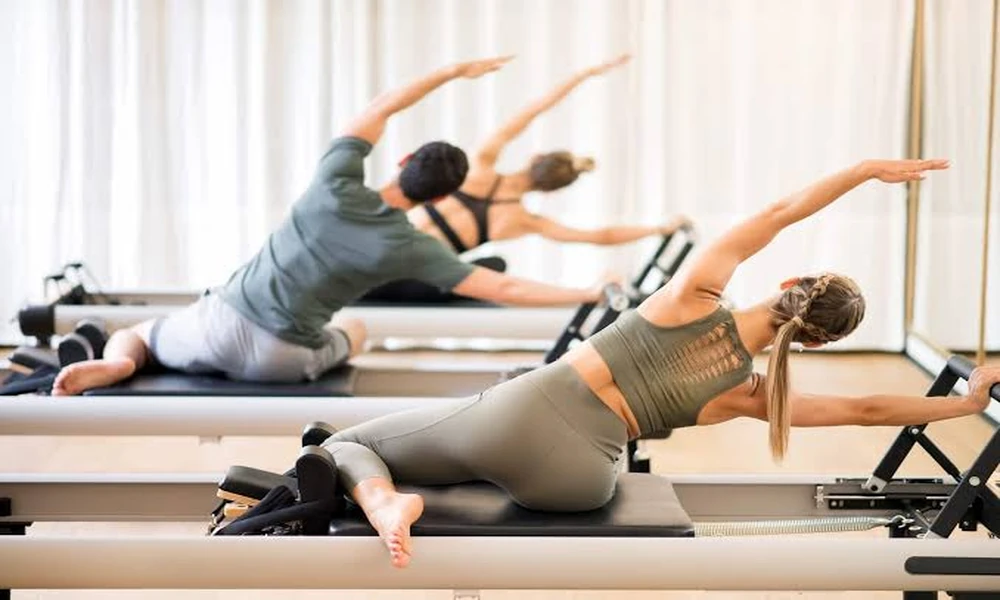
Stress, poor postures or regular daily movement can result in muscle tension. Reformer Pilates involves the use of spring resistance and controlled movement to tackle tension at the beginning. This guide reveals the ways in which Reformer pilates lessen muscle tension. Specific movements enhance relaxation and free tension.
The role of spring resistance in muscle release
The Reformer machine features resistive springs which could be adjusted to achieve changing resistance during every movement. With this spring system, the muscles can be designed to perform a complete range of motion yet remain controlled. The restrained lengthening phase of every workout aids in disengaging stiff fascia and muscles. This is the way that the design of the Reformer contributes to releasing tension:
- Eccentric loading helps release tightness: Muscles become stronger and are stretched at the same time which enables chronic tightness to be released with time.
- Variable resistance from springs challenges safely: The springs change tension safely challenging muscles safely through their full range of movement without strain.
- Supportive sliding carriage reduces joint impact: The sliding bed minimizes the impact on joints and permits deep stretching and lengthening of muscles.
Breathwork and nervous system regulation
The focus of each session of Reformer Pilates is controlled breathing. Breath control whilst moving activates the parasympathetic nervous system, which overrides the stress response. This is a natural flow which assists in reducing cortisol level and giving signals to release tension in the muscles. The important aspects of breathing and relaxation are:
- Mindful breathing patterns calm the system: Deep slow, controlled breaths relax the nervous system and decrease anxiety session-by-session.
- Relaxation response activates naturally: The organism is out of the combat mode or fight-flight, the body switches to the digestive mode by means of concentrated breathing.
- Mind-body connection improves focus: Concentration on breathing assists in silencing the distracting thoughts and allows concentration during motions.
Targeting deep stabilizer muscles
Reformer Pilates involves deep core stabilizers which are usually overlooked during other exercises. These are the transverse abdominis, pelvic floor and multifidus. The enhancement of these stabilizers enhances the posture and minimizes the tension of compensation that brings pain. Deep stabilizer involvement encompasses:
- Core activation stabilizes the spine: The deep core stabilizes the spine prior to initiating any movement of the limbs.
- Balanced development prevents overuse: There is no overwork or underwork on any one muscle group in Reformer sessions.
- Corrected imbalances relieve overworked muscles: The weak muscles strengthen so as to take the strain off the overworked ones.
Summary
Reformer Pilates provides an effective, natural way of reducing muscle tension. It is combined with spring resistance, controlled breathing, and deep stabilizer work in order to release tight muscles and regulate the nervous system. To people who are in need of releasing some of the chronic tension, Reformer Pilates introduces a long-term solution of having a relaxed and balanced body.