

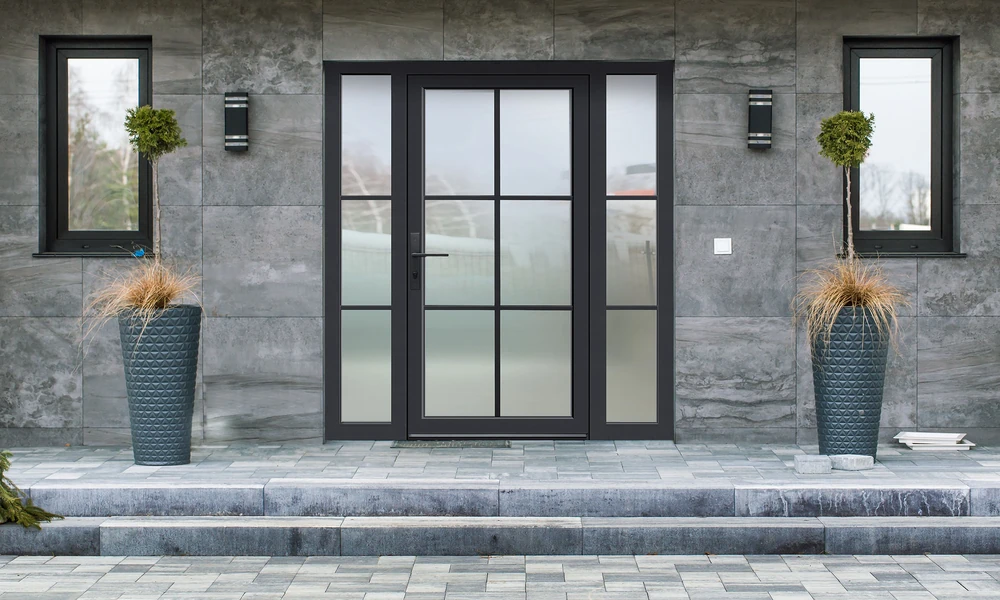
I watched a neighbor in Gilbert spend three weekends hand-sanding a wood front door that the July sun had wrecked in a single season. Twelve hundred dollars in refinishing labor, gone before the first monsoon. That door is now a powder-coated matte black aluminum entry doors unit, and nobody in the family misses the sanding.
Aluminum has quietly become the default front door material in the Sonoran Desert, and it isn’t hard to see why. The metal doesn’t rot, doesn’t swell, doesn’t feed termites, and doesn’t care that surface temperatures on an east-facing entry can run hot enough to cook an egg by mid-morning. If you’re shopping for a front door in Phoenix, Tucson, or Prescott, this guide covers what actually matters: sizing, finishes, thermal performance, and the mistakes that cost people real money.
Why Aluminum Beats Wood and Steel in a Desert Climate
Wood doors fail here in a predictable sequence. The sun bakes out the natural oils, the humidity swing between monsoon season and dry spring cracks the finish, and water finds the gaps. Steel has its own problem: it’s heavy, it rusts at any scratch that reaches bare metal, and a west-facing steel slab in August becomes a radiator pointed at your foyer.
Aluminum sidesteps all of that. It’s naturally corrosion resistant, roughly a third the weight of steel, and it takes a powder coat finish that holds color for years under UV exposure. That last point is the one nobody mentions until year six, when their neighbors’ painted doors have gone chalky white and the aluminum ones still look like the day they were hung.
The material also handles the desert’s other great enemy: dust. Fine silt works its way into every gap on a property, and doors with complex joinery collect it. A slim aluminum frame with a clean gasket line wipes down in under a minute.
What Should You Look For in Aluminum Entry Doors?
Four things separate a door that lasts fifteen years from one that lasts five. Get these right and the rest is aesthetics.
Thermal breaks. Aluminum conducts heat, which is exactly what you don’t want in a front door. A thermal break is a non-conductive barrier molded into the frame that stops heat from traveling straight from the exterior to the interior. Without it, the metal itself becomes a bridge and your entry area stays hot no matter how good the glass is. Ask the seller directly whether the frame, the panel, and the glass are all broken. Half-answers mean half a solution.
Insulated glass. Double-pane units with a low-emissivity coating are the floor, not the upgrade, in this climate. The physics is straightforward, and the U.S. Department of Energy’s Office of Energy Efficiency and Renewable Energy explains how low-E coatings and gas fills cut radiant heat transfer through glass. In practice, that’s the difference between a foyer that’s merely warm and one that’s genuinely uncomfortable at 6 p.m. in July.
Frame depth and finish. Standard residential walls take standard frame depths, but older Arizona homes sometimes run thicker. Measure your actual wall, not the door you’re replacing, because a previous owner may have already altered it. On finish, powder coat outperforms wet paint by a wide margin. Matte black and white are the two most specified colors in the Southwest, and both hide dust better than gloss.
Security hardware. Multi-point locking is worth the money. A single deadbolt on a glass-heavy door is mostly theater. Look for reinforced strike plates set into the frame rather than surface-mounted.
Sizing, Swing, and Hardware Decisions That Trip People Up
The single most common mistake I see is ordering before measuring the rough opening. The rough opening is the framed gap in the wall, and it runs wider and taller than the door unit itself to allow for shimming and leveling. Measure the opening at three points, top, middle, and bottom, and use the smallest number. Arizona slabs settle, and a rough opening that’s square at the top can be off by three quarters of an inch at the threshold.
Then decide swing direction with your furniture in mind, not the old door’s hinge side. A door that swings into a coat rack is a daily annoyance. Entry doors typically swing inward, but the hinge side is a real choice, and it changes how the entry feels when you walk in.
For multi-panel configurations, standard code requirements matter for how the panels are set and reinforced. The National Institute of Standards and Technology maintains the building and fire standards resources that shape how these systems get tested, and it’s a fair explanation for why a custom door often costs more than a stock one. Testing and certification aren’t free.
Custom vs. Stock: A Decision Framework
Here’s the framework I’d hand a friend. Work through it in order and stop at the first “custom” answer.
- Does your rough opening match a standard stock size within half an inch? If no, go custom.
- Do you need a sidelight, transom, or an asymmetrical panel layout? If yes, go custom.
- Is your finish anything other than matte black or white? If yes, expect a custom lead time.
- Is the door going into a commercial space with egress requirements? Go custom, and get the paperwork.
- If you answered no to everything, a stock unit will save you both money and weeks of waiting.
Stock doors get installed fast, sometimes in a single day, and that speed is genuinely worth something when your entry is currently a hole in the wall. Custom work takes longer but gets you a door that looks like it was designed for the house instead of dropped onto it. My own bias: if you’re staying in the home for five years or more, custom pays for itself in daily satisfaction. If you’re flipping, stock wins.
Living With Aluminum Through Monsoon Season
Aluminum doesn’t care about rain. The seals around it do. Monsoon season dumps more water in an hour than most door assemblies see in a month, and the failure point is almost always the threshold and the weatherstripping, not the panel.
Before the season starts, do three things. Check that the threshold sits above the exterior slab and drains away from the wall. Run a finger along the weatherstripping and replace anything that’s cracked or compressed flat. And confirm the weep holes at the bottom of the frame are clear, because blocked weep holes turn a door frame into a shallow bathtub. The National
Oceanic and Atmospheric Administration tracks the seasonal monsoon patterns that drive these storms, and the timing is reliable enough to put on a calendar.
Dust maintenance is simpler than most people expect. A microfiber cloth and a mild soap solution once a month handles it. Skip abrasive cleaners, which dull powder coat over time, and skip silicone sprays, which attract grit.
The Bottom Line on Choosing a Door
Aluminum entry doors solve a problem that wood and steel can’t solve in the desert. They hold their finish, they shrug off heat, and they don’t demand a weekend of labor every year to stay presentable. Get the thermal break, get the insulated glass, measure your rough opening three times, and decide between stock and custom based on how long you plan to stay.
What’s the orientation of your front door, east or west? That single fact should drive half of your buying decision, and most people never think to ask.