

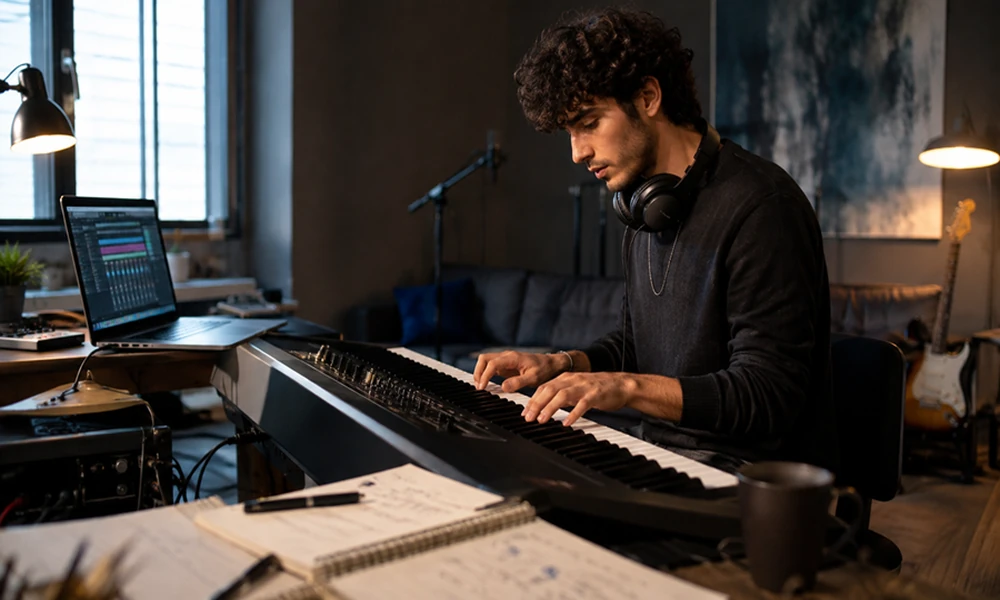
Strong piano technique gives keyboardists an important foundation, but contemporary musicians are often asked to do far more than execute scales, chords, and written parts accurately. A keyboard player may need to support a vocalist one day, shape synthesizer sounds the next, improvise during a live set, or create an arrangement that leaves room for an entire band.
Developing into a versatile keyboardist therefore means looking beyond technical proficiency alone. The most adaptable players build a combination of musical judgment, listening skills, stylistic awareness, technological confidence, and collaborative ability.
Build a Vocabulary That Works Across Musical Styles
Knowing how to play a chord is different from knowing how that chord should function in a particular style.
The same harmonic progression can call for very different approaches depending on whether the music is funk, rock, jazz, R&B, pop, blues, or another contemporary genre. A keyboardist may need sparse rhythmic voicings in one setting and sustained harmonic textures in another. Simply transferring the same playing habits from song to song can make an otherwise capable musician sound out of place.
Instead of learning styles only as collections of songs, study the musical characteristics behind them. Pay attention to rhythmic placement, articulation, voicing, improvisational language, sound choice, and the relationship between the keyboard and rhythm section.
Transcribing keyboard parts can be particularly useful. Rather than only learning which notes were played, ask why the musician chose that register, rhythm, voicing, or amount of space. That process gradually turns imitation into a flexible musical vocabulary.
Learn to Play for the Ensemble, Not Just Yourself
Keyboard instruments can occupy an enormous amount of harmonic and frequency space. That makes listening especially important when playing with other musicians.
A keyboardist who uses large two-handed voicings while a guitarist, bassist, vocalist, and second keyboard player are active may create clutter even when every individual note is technically correct. Effective ensemble playing often requires doing less.
Practice reacting to what other musicians contribute. If the bass player is clearly defining the root movement, the keyboard part may not need to duplicate it. If a guitarist is filling the middle register, a higher texture or simpler voicing may work better. When a singer enters, reducing rhythmic activity can create room for the vocal.
This kind of musical judgment is difficult to develop through isolated practice alone. Rehearsals, jam sessions, accompaniment work, ensembles, and regular live performance expose players to the constant adjustments that real collaboration requires.
Connect Performance Skills With Modern Keyboard Technology
Contemporary keyboard playing increasingly involves understanding the instrument as both a performance tool and a source of sound.
A pianist moving to synthesizers, workstations, software instruments, or digital recording systems encounters an entirely new set of decisions. Players may need to organize patches, layer sounds, control dynamics, work with samples, understand basic synthesis, record parts, or create textures that fit an arrangement.
Technology should support musicianship rather than replace it. Learning every menu on a synthesizer matters less than understanding why a particular sound works in a particular musical context. Start with practical goals: recreate a useful pad, shape a lead so it cuts through an ensemble, record a clean keyboard part, or build several sounds that can be changed efficiently during a performance.
Musicians looking for a more structured path can also examine how a keyboard performance degree program combines areas such as performance, improvisation, arranging, recording, and contemporary keyboard technology, then compare that approach with the gaps in their own development.
The objective is not to collect technical skills for their own sake. It is to become capable of translating a musical idea into the appropriate sound, whether on stage, in rehearsal, or during a recording session.
Develop Arranging and Musical Decision-Making Skills
Keyboardists frequently see harmony in a particularly visual way. Chords, inversions, bass movement, countermelodies, and inner voices are all immediately accessible across the instrument.
That makes the keyboard a powerful tool for arranging.
Begin by taking familiar songs and deliberately changing one musical element at a time. Try a different chord inversion, remove notes from dense voicings, change the rhythmic pattern beneath a melody, or create an introduction using material already present in the song.
Then practice arranging with other instruments in mind. Ask what the bass should handle, where a guitar might sit, how much harmonic information a vocalist needs underneath a melody, and which parts should disappear when the arrangement becomes crowded.
These exercises shift the focus from “What can I play?” to “What does this piece need?” That change in perspective is one of the most valuable steps toward professional-level musicianship.
Arranging ability also improves performance. When players understand the function of every part, they can react more intelligently when a band changes dynamics, extends a section, simplifies an arrangement, or moves unexpectedly during a live performance.
Create a Practice Routine Around Real Musical Situations
Technique still matters, but it becomes more valuable when connected to realistic applications.
Instead of spending every practice session on isolated exercises, divide the time among several areas. Work on technique and harmonic vocabulary, learn complete songs, improvise over unfamiliar progressions, practice with backing tracks or other musicians, program useful sounds, and record yourself.
Recording is particularly revealing. Listening back often exposes problems that are difficult to notice while playing, including inconsistent timing, overly busy accompaniment, abrupt sound changes, or poor balance between the hands.
It is also useful to introduce constraints. Play an entire verse using only three-note voicings. Accompany a melody without playing roots. Recreate a part in a different register. Perform a song using two contrasting sounds and practice switching between them smoothly.
Constraints force musicians to make decisions rather than simply repeat familiar patterns.
Conclusion
Becoming a capable modern keyboardist involves more than accumulating difficult pieces or increasing technical speed. The broader goal is musical adaptability: knowing what to play, how to support other musicians, which sound fits the situation, and when restraint is more effective than complexity.
Technical practice, stylistic study, ensemble experience, arranging, recording, and keyboard technology all reinforce one another. By developing them together, a player becomes better prepared not only to perform keyboard parts, but to contribute intelligently to the music around them.