Consider the following when selecting plants for plant containers. Is there a lot of growth at the bottom? Are the leaves in good condition, with no spots or pests? Will the plant’s size, as stated on the tag, meet your requirements? Does the plant’s growing requirements match the location of the container—are you putting it in full sun, shade, or part sun and shade?
Consider the thrill, fill, spill concept. Place one plant in the center to “thrill” the eye and draw attention, “fill” the planter with accenting color, and choose one or two plants to “spill” over the sides to soften the appearance. The spike dracaena is a popular “thrill” plant among gardeners. Red fountain grass is my favorite, but you could also try snapdragons, salvia, coleus, or dahlias. African daisies (Osteospermum sp.), million bells (Calibrachoa sp.), zinnias, and geraniums are good “fill” plants. Wave petunias, sweet potato vine, alyssum, and lobelia are examples of “spill” plants.
You can create four-season containers by completely changing some pots each season or simply changing a few plants. Plant bulbs, pansies, dianthus, primulas, lobelias, and snapdragons in the spring. In the summer, try tropical plants like cannas or miniature sunflowers. For my summer containers, Autumn colors include oranges, deep golds, and deep reds. Don’t be afraid to mix in some perennials in your plant containers. Group your planters by varying their heights, such as by standing some on bricks.
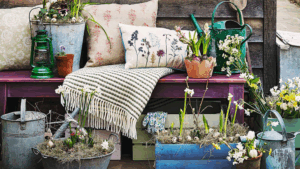
In the garden, use large, eye-catching containers. Use them as specimens or sculptural accents in a flower or shrub border.
To prevent soil from clogging the hole in the bottom of the planter, cover it with a rock or a piece of landscape fabric and fill it with media. Fill the plant container halfway to three-quarters full. Place your transplants in the mix, then add potting media to one inch below the rim and lightly press. Plant seeds and transplants at the depth and spacing specified on the seed packet or tag. Place your container in a location where it will receive the required amount of sunlight.
The soil in containers can quickly dry out, so check at least once a day and water as needed. Do not allow the media to dry completely. Apply water until it runs out of the bottom hole.
Fertilize every couple of weeks with the fish emulsion at the dilution recommended on the bottle. If you bought a soil mix with added fertilizer, you won’t have to do this for another eight to ten weeks.